
 CONFERENCE
Workshop November 2025
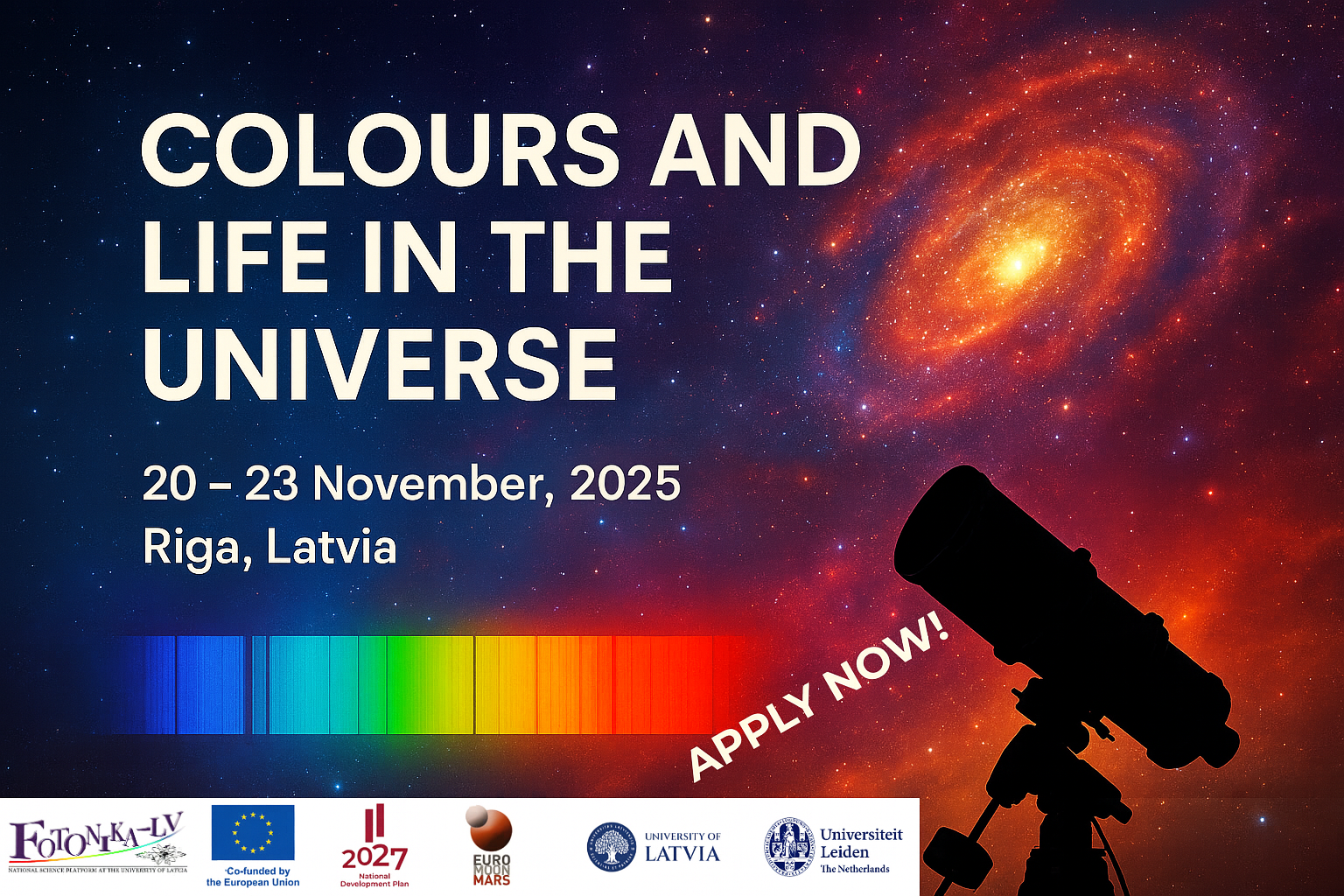
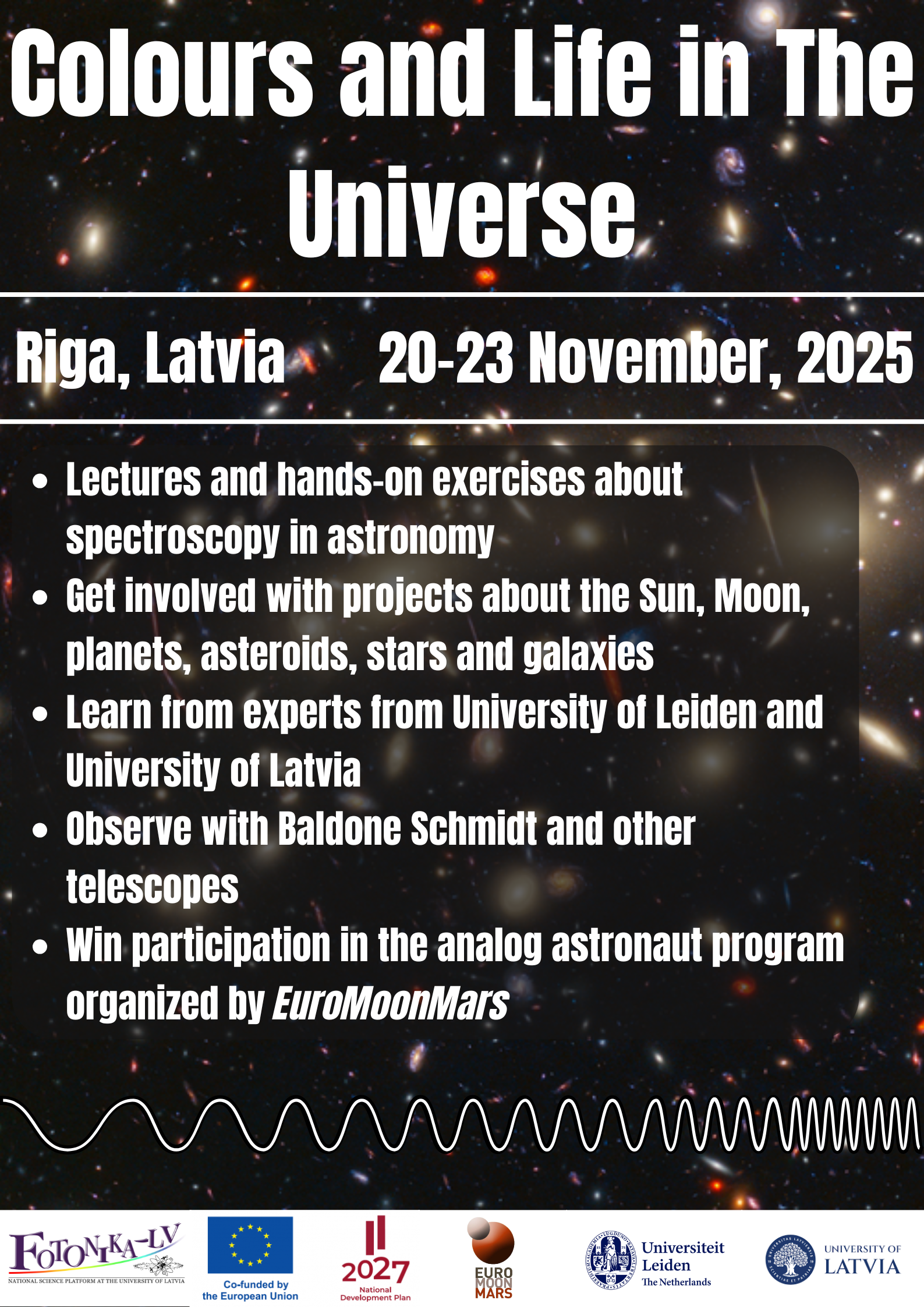
University of Latvia, Institute of Astronomy, is organizing a space research related workshop “Colours and Life in The Universe”, 20 - 23 November 2025 at Riga, Latvia, University of Latvia.
Head of the organizing committee: ERA Chair Dr. Bernard Foing (University of Latvia, Riga; Leiden University, Netherlands)
Secretary of the organizing committee: MSc. Kristers Nagainis (University of Latvia, Riga), Kristers.Nagainis@lu.lv
Workshop is organized within ERDF project No. 1.1.1.5/2/24/A/004
Announcement:
"Are you a student or a young scientist who is interested in learning more about our Universe? Then join the workshop “Colours and Life in The Universe” in 20th to 23rd of November 2025 in Riga, House of Science and Baldone observatory!
You will learn about the vast information hidden in the spectra of various objects found both in the near neighbourhood – Sun, Moon, planets, asteroids – but also of far away stars and even galaxies. Not only that, you will conduct your own observations with different telescopes (even with the large Baldone Schmidt telescope), learn how to analyze spectroscopic data, and work in teams to finish and present a project."
The universe is vast and full of the unknown, and it is difficult to uncover its secrets – we still cannot reach other stars or galaxies, nor go back to the very beginning of the Universe to learn more about it. But we can observe various cosmic objects, for example stars in the Milky Way, and from these observations learn both about the physical processes taking place within them, their effects on the surrounding environment, and their origins.
To learn as much as possible about these objects, we can disperse the light they emit into a spectrum. This immediately gives us a wealth of additional information – about their distance, composition, type, what lies between us and them, and much more. Spectroscopy is a powerful observational tool that allows us to reveal the true, colourful nature of the Universe.
In this workshop you will have the chance to learn about the information spectroscopy provides on various cosmic objects, the instruments needed to obtain spectra, the methods required to process spectroscopic data, and the signatures of life that must be searched for. All of this will be taught by experts in the field from Leiden University (The Netherlands) and the University of Latvia.
In addition, participants will be able to carry out their own observations, process them, and draw conclusions for projects of their own interest. Several projects in different themes have been prepared for the workshop – on the Solar System, on stars in our Galaxy, and even on other galaxies. To carry out these projects, participants can observe with the Baldone Schmidt telescope – the 12th largest Schmidt telescope in the world – or with other telescopes.
Lectures and practical sessions will take place on 20 and 21 November in the House of Science. Project development and observations will be carried out at the Baldone Observatory in Baldone. Transport to and from Baldone, accommodation in Baldone, coffee breaks and lunch will be provided in the workshop. It is mandatory to participate for the first two days of the workshop in Riga, but the project development in Baldone is optional.
At the end of the workshop, participants will have the opportunity to give presentations on their project work. The best team will win a chance to take part in an analog astronaut program organized by EuroMoonMarsPoland (EMMPOL). Participants who attend both the lectures and the project work in Baldone will receive a certificate accordingly.
Workshop lecturers and experts:
- Prof. Bernard Foing — ESA, EuroMoonMars
- Dr. Salim Ansari — ESA (Gaia)
- Dr. Gülin Dede — ESA ESTEC
- Dr. Ilgmārs Eglītis — UL Baldone Observatory
- Lev Lapkis — LAIK, ESA BIC
- Kristers Nagainis — Euclid
- Jara Pascual — Collabwith, EuroSpaceHub
- Dr. Kārlis Puķītis — UL Laser Centre
- Vilma Purienė — VILNIUS TECH
- Prof. Andris Slavinskis — RTU, ESA Comet Interceptor
- Dr. Arnolds Ūbelis — UL FOTONIKA-LV
- Dr. Mojtaba Raouf Hajar Zarrin — Leiden Observatory
Programme: Schedule for Workshop (version of 19.11.2025.)
Participation fee:
Participation is free, but registration is required
Registration:
Registration is open until 15th October. Post-deadline registration is possible until all places are filled. To register, please complete the form at: https://forms.gle/KLxCZ9MLVghNfdcf8
The maximum number of participants: 30. Each application will be evaluated based on the CV and registration form.
Language of the workshop: English
After the workshop, students will have the possibility to finish a report on the conducted project, and apply for 2 ETCS.